


VW and most of the major car manufacturers


Thread Starter
Scooby Regular
iTrader: (1)
Joined: Aug 2004
Posts: 6,296
Likes: 118
From: Api 500+bhp MD321T @91dB Probably SN's longest owner of an Impreza Turbo

Our 2018 Leaf is imminent for delivery. The first one was delivered this weekend. My dealer has received the showroom model and demonstrators arrive this week.

Scooby Regular

Joined: May 2001
Posts: 1,050
Likes: 11
From: The co-drivers seat
Wonder if you can charge these cars off a petrol generator. You can get small, light "inverter" type generators from Honda, Kipor etc. I use one to charge batteries for my RC stuff when out.

Thread Starter
Scooby Regular
iTrader: (1)
Joined: Aug 2004
Posts: 6,296
Likes: 118
From: Api 500+bhp MD321T @91dB Probably SN's longest owner of an Impreza Turbo
As long as it produces 230 ac power then yes, albeit slowly. Unless a massive generator

Joined: Apr 2002
Posts: 38,078
Likes: 310
From: The hell where youth and laughter go
Yes; Well certainly you can with a Tesla Model S; We had to charge the one in the workshop (awaiting parts)...You can select charge time and current draw, which was handy if its plugged into a shared spur so not to overload it.
What you want is a water cooled Lister/Listeroid set up for biofuel and used as part of a off grid CHP setup. That way the heat from the engine and exhaust gets recovered into a hot water accumulator/heat bank. Bonus points awarded if you use a belt to drive a refrigerant compressor as part of a heat pump system
News today; Congestion costing the economy billions. Causing pollution. Wasting fuel etc. (Kidderminster one of the worst; a small town surrounded by green belt!...no doubt because of the cancelled road building resulting in a half-ring road to nowhere, then they made the only dual carriageway into single lanes )
)
Its the same all over again...office drones and mummies using cars when they shouldn't be and/or living too far from where they work. But of course a nice big city salary and a cheaper house out if the 'burbs is all worth it. Just waste your hours sitting in a traffic jam in a electric car instead...problem solved (not)!
What you want is a water cooled Lister/Listeroid set up for biofuel and used as part of a off grid CHP setup. That way the heat from the engine and exhaust gets recovered into a hot water accumulator/heat bank. Bonus points awarded if you use a belt to drive a refrigerant compressor as part of a heat pump system
News today; Congestion costing the economy billions. Causing pollution. Wasting fuel etc. (Kidderminster one of the worst; a small town surrounded by green belt!...no doubt because of the cancelled road building resulting in a half-ring road to nowhere, then they made the only dual carriageway into single lanes
)Its the same all over again...office drones and mummies using cars when they shouldn't be and/or living too far from where they work. But of course a nice big city salary and a cheaper house out if the 'burbs is all worth it. Just waste your hours sitting in a traffic jam in a electric car instead...problem solved (not)!
Last edited by ALi-B; Feb 6, 2018 at 06:50 PM.

18 June 1815 - Waterloo
iTrader: (31)
Joined: Dec 2004
Posts: 19,156
Likes: 15
From: To the valley men!

Thread Starter
Scooby Regular
iTrader: (1)
Joined: Aug 2004
Posts: 6,296
Likes: 118
From: Api 500+bhp MD321T @91dB Probably SN's longest owner of an Impreza Turbo

18 June 1815 - Waterloo
iTrader: (31)
Joined: Dec 2004
Posts: 19,156
Likes: 15
From: To the valley men!
It needs the torque to shift its bulk The Leaf weights 1557 kgs. 3 x fatties more than an average Impreza Turbo.
Lithium battery recycling is well, at best difficult.
Source material prices are rising.
How many charging points exist?
What is the true enviromental damage of extracting the raw ingredients?
Last edited by The Trooper 1815; Feb 6, 2018 at 10:37 PM.
Thread Starter
Scooby Regular
iTrader: (1)
Joined: Aug 2004
Posts: 6,296
Likes: 118
From: Api 500+bhp MD321T @91dB Probably SN's longest owner of an Impreza Turbo
Lets put this into perspective.
It needs the torque to shift its bulk The Leaf weights 1557 kgs. 3 x fatties more than an average Impreza Turbo.
Lithium battery recycling is well, at best difficult.
Source material prices are rising.
How many charging points exist?
What is the true enviromental damage of extracting the raw ingredients?
It needs the torque to shift its bulk The Leaf weights 1557 kgs. 3 x fatties more than an average Impreza Turbo.
Lithium battery recycling is well, at best difficult.
Source material prices are rising.
How many charging points exist?
What is the true enviromental damage of extracting the raw ingredients?
Recycling can be done of batteries, who said it easy. Recycling will need to further improved, just like every other vehicle.
There are many thousands of charge points currently, expansion is rapid. Don't forget every household is charge point.
go and compare crude oil extraction.
Then we go for emissions for the life of the vehicle, currently around 30% of UK energy is generated by renewable sources and upto 50% from low carbon sources. Don't forget home solar aswell, so free power .
You're going off tangent, it's a local commuter vehicle, where 95% of all car journeys are under 30miles. This is not just for me, the whole of the UK does this every day.
For the majority, electric is the perfect local commute energy source. Improved air quality for every electric car journey in cities and towns. Children s health and those with respiratory issues.
You and many others will be driving a zero emissions vehicle in a very short while.

18 June 1815 - Waterloo
iTrader: (31)
Joined: Dec 2004
Posts: 19,156
Likes: 15
From: To the valley men!
It's no hot hatch but similarly torque is available from zero to max speed, so makes for a punchy acceleration
Recycling can be done of batteries, who said it easy. Recycling will need to further improved, just like every other vehicle.
There are many thousands of charge points currently, expansion is rapid. Don't forget every household is charge point.
go and compare crude oil extraction.
Then we go for emissions for the life of the vehicle, currently around 30% of UK energy is generated by renewable sources and upto 50% from low carbon sources. Don't forget home solar aswell, so free power .
You're going off tangent, it's a local commuter vehicle, where 95% of all car journeys are under 30miles. This is not just for me, the whole of the UK does this every day.
For the majority, electric is the perfect local commute energy source. Improved air quality for every electric car journey in cities and towns. Children s health and those with respiratory issues.
You and many others will be driving a zero emissions vehicle in a very short while.
Recycling can be done of batteries, who said it easy. Recycling will need to further improved, just like every other vehicle.
There are many thousands of charge points currently, expansion is rapid. Don't forget every household is charge point.
go and compare crude oil extraction.
Then we go for emissions for the life of the vehicle, currently around 30% of UK energy is generated by renewable sources and upto 50% from low carbon sources. Don't forget home solar aswell, so free power .
You're going off tangent, it's a local commuter vehicle, where 95% of all car journeys are under 30miles. This is not just for me, the whole of the UK does this every day.
For the majority, electric is the perfect local commute energy source. Improved air quality for every electric car journey in cities and towns. Children s health and those with respiratory issues.
You and many others will be driving a zero emissions vehicle in a very short while.
Thread Starter
Scooby Regular
iTrader: (1)
Joined: Aug 2004
Posts: 6,296
Likes: 118
From: Api 500+bhp MD321T @91dB Probably SN's longest owner of an Impreza Turbo
So you live in a major town or city. Therefore more charging points available for you if you had an electric car to charge at one of the stations. Or you should be using public transport or walking/cycle

Scooby Regular
Joined: Oct 2004
Posts: 2,684
Likes: 0
From: If you're not braking or accelerating you're wasting time.
So stop making sweeping statements that are blatantly untrue to support your argument.
There a 3 stations near me.None have a charge point.If they did would I have to wait & charge the car before I park & get on the train?What about lf the other commuters queuing to do the same.Maybe I should arrive 3 hours early just to make sure.It's not workable is it really?
I am not against electric cars.Just show me a genuine working solution that has been thought through.
There a 3 stations near me.None have a charge point.If they did would I have to wait & charge the car before I park & get on the train?What about lf the other commuters queuing to do the same.Maybe I should arrive 3 hours early just to make sure.It's not workable is it really?
I am not against electric cars.Just show me a genuine working solution that has been thought through.
Thread Starter
Scooby Regular
iTrader: (1)
Joined: Aug 2004
Posts: 6,296
Likes: 118
From: Api 500+bhp MD321T @91dB Probably SN's longest owner of an Impreza Turbo
So stop making sweeping statements that are blatantly untrue to support your argument.
There a 3 stations near me.None have a charge point.If they did would I have to wait & charge the car before I park & get on the train?What about lf the other commuters queuing to do the same.Maybe I should arrive 3 hours early just to make sure.It's not workable is it really?
I am not against electric cars.Just show me a genuine working solution that has been thought through.
There a 3 stations near me.None have a charge point.If they did would I have to wait & charge the car before I park & get on the train?What about lf the other commuters queuing to do the same.Maybe I should arrive 3 hours early just to make sure.It's not workable is it really?
I am not against electric cars.Just show me a genuine working solution that has been thought through.
Do you have off street parking at home?


Scooby Regular
Joined: Dec 2002
Posts: 1,457
Likes: 3
Found testing on monkeys with diesel emissions. Suppressed the results because it was shown newer diesels are more lethal in their toxic emissions than older vehicles despite having a cheat system to lower emissions.
*******s the lot of them. Don't buy German cars.
http://www.telegraph.co.uk/news/2018...-cars-harmful/
*******s the lot of them. Don't buy German cars.
http://www.telegraph.co.uk/news/2018...-cars-harmful/
Thread Starter
Scooby Regular
iTrader: (1)
Joined: Aug 2004
Posts: 6,296
Likes: 118
From: Api 500+bhp MD321T @91dB Probably SN's longest owner of an Impreza Turbo
Hurrah, German court allows cities to ban diesel from entering to tackle chronic pollution. 
Come on UK ban these ****ers off the road
Go Electric
Come on UK ban these ****ers off the road
Go Electric
18 June 1815 - Waterloo
iTrader: (31)
Joined: Dec 2004
Posts: 19,156
Likes: 15
From: To the valley men!
Are cows the cause of global warming?
A cow does on overage release between 70 and 120 kg of Methane per year. Methane is a greenhouse gas like carbon dioxide (CO2). But the negative effect on the climate of Methane is 23 times higher than the effect of CO2. Therefore the release of about 100 kg Methane per year for each cow is equivalent to about 2'300 kg CO2 per year.
Let's compare this value of 2'300 kg CO2: The same amount of carbon dioxide (CO2) is generated by burning 1'000 liters of petrol. With a car using 8 liters of petrol per 100 km, you could drive 12'500 km per year (7'800 miles per year).
World-wide, there are about 1.5 billion cows and bulls. All ruminants (animals which regurgitates food and re-chews it) on the world emit about two billion metric tons of CO2-equivalents per year. In addition, clearing of tropical forests and rain forests to get more grazing land and farm land is responsible for an extra 2.8 billion metric tons of CO2 emission per year!
According to the Food and Agriculture Organization of the United Nations (FAO) agriculture is responsible for 18% of the total release of greenhouse gases world-wide (this is more than the whole transportation sector). Cattle-breeding is taking a major factor for these greenhouse gas emissions according to FAO. Says Henning Steinfeld, Chief of FAO's Livestock Information and Policy Branch and senior author of the report: "Livestock are one of the most significant contributors to today's most serious environmental problems. Urgent action is required to remedy the situation."
Livestock now use 30 percent of the earth's entire land surface, mostly permanent pasture but also including 33 percent of the global arable land used to producing feed for livestock, the report notes. As forests are cleared to create new pastures, it is a major driver of deforestation, especially in Latin America where, for example, some 70 percent of former forests in the Amazon have been turned over to grazing.
Are cows to blame for global warming? Are cattle the true cause for climate change?
We cannot deny that farming has a major impact on global warming. Since farming is basically serving the consumer's demand for food, we should look at our nourishment. With increased prosperity, people are consuming more meat and dairy products every year. Global meat production is projected to more than double from 229 million tonnes in 1999/2001 to 465 million tonnes in 2050, while milk output is set to climb from 580 to 1043 million tonnes.
A Japanese study showed that producing a kilogram of beef leads to the emission of greenhouse gases with a global warming potential equivalent to 36.4 kilograms of carbon dioxide (CO2). It also releases fertilising compounds equivalent to 340 grams of sulphur dioxide and 59 grams of phosphate, and consumes 169 megajoules of energy (Animal Science Journal, DOI: 10.1111/j.1740-0929.2007.00457.x). In other words, a kilogram of beef is responsible for the equivalent of the amount of CO2 emitted by the average European car every 250 kilometres, and burns enough energy to light a 100-watt bulb for nearly 20 days (New Scientist magazine, 18 July 2007, page 15 ).
The following tables indicates the CO2 production in kg CO2 equivalents per kg of meat depending on the animal:
1 kg of meat from - produces kg CO2e
beef 34.6
lamb 17.4
pork 6.35
chicken 4.57
Source: Environmental Impacts on Food Production and Consumption. http://www.defra.gov.uk/science/proj...7_4601_FRP.pdf
Conclusion: Eat less meat and dairy products.
The most important conclusion for ourselves is: Eat much less meat and dairy products. This is one of the most effective ways to reduce our personal carbon footprint and to generally reduce our personal negative impact on the environment.
Finally a quote from Albert Einstein (Nobel prize 1921): Nothing will benefit human health and increase chances for survival of life on Earth as much as the evolution to a vegetarian diet.
18 June 1815 - Waterloo
iTrader: (31)
Joined: Dec 2004
Posts: 19,156
Likes: 15
From: To the valley men!
It does not mean they will ban anything yet. A vote needs to be won.
Last edited by The Trooper 1815; Feb 28, 2018 at 01:19 PM.

Scooby Regular


Joined: Jul 2008
Posts: 15,634
Likes: 22
From: K
Let's ban cattle (because of methane) and go veggie.
Are cows the cause of global warming?
A cow does on overage release between 70 and 120 kg of Methane per year. Methane is a greenhouse gas like carbon dioxide (CO2). But the negative effect on the climate of Methane is 23 times higher than the effect of CO2. Therefore the release of about 100 kg Methane per year for each cow is equivalent to about 2'300 kg CO2 per year.
Let's compare this value of 2'300 kg CO2: The same amount of carbon dioxide (CO2) is generated by burning 1'000 liters of petrol. With a car using 8 liters of petrol per 100 km, you could drive 12'500 km per year (7'800 miles per year).
World-wide, there are about 1.5 billion cows and bulls. All ruminants (animals which regurgitates food and re-chews it) on the world emit about two billion metric tons of CO2-equivalents per year. In addition, clearing of tropical forests and rain forests to get more grazing land and farm land is responsible for an extra 2.8 billion metric tons of CO2 emission per year!
According to the Food and Agriculture Organization of the United Nations (FAO) agriculture is responsible for 18% of the total release of greenhouse gases world-wide (this is more than the whole transportation sector). Cattle-breeding is taking a major factor for these greenhouse gas emissions according to FAO. Says Henning Steinfeld, Chief of FAO's Livestock Information and Policy Branch and senior author of the report: "Livestock are one of the most significant contributors to today's most serious environmental problems. Urgent action is required to remedy the situation."
Livestock now use 30 percent of the earth's entire land surface, mostly permanent pasture but also including 33 percent of the global arable land used to producing feed for livestock, the report notes. As forests are cleared to create new pastures, it is a major driver of deforestation, especially in Latin America where, for example, some 70 percent of former forests in the Amazon have been turned over to grazing.
Are cows to blame for global warming? Are cattle the true cause for climate change?
We cannot deny that farming has a major impact on global warming. Since farming is basically serving the consumer's demand for food, we should look at our nourishment. With increased prosperity, people are consuming more meat and dairy products every year. Global meat production is projected to more than double from 229 million tonnes in 1999/2001 to 465 million tonnes in 2050, while milk output is set to climb from 580 to 1043 million tonnes.
A Japanese study showed that producing a kilogram of beef leads to the emission of greenhouse gases with a global warming potential equivalent to 36.4 kilograms of carbon dioxide (CO2). It also releases fertilising compounds equivalent to 340 grams of sulphur dioxide and 59 grams of phosphate, and consumes 169 megajoules of energy (Animal Science Journal, DOI: 10.1111/j.1740-0929.2007.00457.x). In other words, a kilogram of beef is responsible for the equivalent of the amount of CO2 emitted by the average European car every 250 kilometres, and burns enough energy to light a 100-watt bulb for nearly 20 days (New Scientist magazine, 18 July 2007, page 15 ).
The following tables indicates the CO2 production in kg CO2 equivalents per kg of meat depending on the animal:
1 kg of meat from - produces kg CO2e
beef 34.6
lamb 17.4
pork 6.35
chicken 4.57
Source: Environmental Impacts on Food Production and Consumption. http://www.defra.gov.uk/science/proj...7_4601_FRP.pdf
Conclusion: Eat less meat and dairy products.
The most important conclusion for ourselves is: Eat much less meat and dairy products. This is one of the most effective ways to reduce our personal carbon footprint and to generally reduce our personal negative impact on the environment.
Finally a quote from Albert Einstein (Nobel prize 1921): Nothing will benefit human health and increase chances for survival of life on Earth as much as the evolution to a vegetarian diet.
Are cows the cause of global warming?
A cow does on overage release between 70 and 120 kg of Methane per year. Methane is a greenhouse gas like carbon dioxide (CO2). But the negative effect on the climate of Methane is 23 times higher than the effect of CO2. Therefore the release of about 100 kg Methane per year for each cow is equivalent to about 2'300 kg CO2 per year.
Let's compare this value of 2'300 kg CO2: The same amount of carbon dioxide (CO2) is generated by burning 1'000 liters of petrol. With a car using 8 liters of petrol per 100 km, you could drive 12'500 km per year (7'800 miles per year).
World-wide, there are about 1.5 billion cows and bulls. All ruminants (animals which regurgitates food and re-chews it) on the world emit about two billion metric tons of CO2-equivalents per year. In addition, clearing of tropical forests and rain forests to get more grazing land and farm land is responsible for an extra 2.8 billion metric tons of CO2 emission per year!
According to the Food and Agriculture Organization of the United Nations (FAO) agriculture is responsible for 18% of the total release of greenhouse gases world-wide (this is more than the whole transportation sector). Cattle-breeding is taking a major factor for these greenhouse gas emissions according to FAO. Says Henning Steinfeld, Chief of FAO's Livestock Information and Policy Branch and senior author of the report: "Livestock are one of the most significant contributors to today's most serious environmental problems. Urgent action is required to remedy the situation."
Livestock now use 30 percent of the earth's entire land surface, mostly permanent pasture but also including 33 percent of the global arable land used to producing feed for livestock, the report notes. As forests are cleared to create new pastures, it is a major driver of deforestation, especially in Latin America where, for example, some 70 percent of former forests in the Amazon have been turned over to grazing.
Are cows to blame for global warming? Are cattle the true cause for climate change?
We cannot deny that farming has a major impact on global warming. Since farming is basically serving the consumer's demand for food, we should look at our nourishment. With increased prosperity, people are consuming more meat and dairy products every year. Global meat production is projected to more than double from 229 million tonnes in 1999/2001 to 465 million tonnes in 2050, while milk output is set to climb from 580 to 1043 million tonnes.
A Japanese study showed that producing a kilogram of beef leads to the emission of greenhouse gases with a global warming potential equivalent to 36.4 kilograms of carbon dioxide (CO2). It also releases fertilising compounds equivalent to 340 grams of sulphur dioxide and 59 grams of phosphate, and consumes 169 megajoules of energy (Animal Science Journal, DOI: 10.1111/j.1740-0929.2007.00457.x). In other words, a kilogram of beef is responsible for the equivalent of the amount of CO2 emitted by the average European car every 250 kilometres, and burns enough energy to light a 100-watt bulb for nearly 20 days (New Scientist magazine, 18 July 2007, page 15 ).
The following tables indicates the CO2 production in kg CO2 equivalents per kg of meat depending on the animal:
1 kg of meat from - produces kg CO2e
beef 34.6
lamb 17.4
pork 6.35
chicken 4.57
Source: Environmental Impacts on Food Production and Consumption. http://www.defra.gov.uk/science/proj...7_4601_FRP.pdf
Conclusion: Eat less meat and dairy products.
The most important conclusion for ourselves is: Eat much less meat and dairy products. This is one of the most effective ways to reduce our personal carbon footprint and to generally reduce our personal negative impact on the environment.
Finally a quote from Albert Einstein (Nobel prize 1921): Nothing will benefit human health and increase chances for survival of life on Earth as much as the evolution to a vegetarian diet.
Err in a word NO
why - well because of something called the earths "Carbon Budget" - the Earth creates natural CO2 / Methane etc and absorbs CO2 / Methane etc in natural cycles
so the Northern hemisphere summer, CO2 is absorbed in the greening of all the trees and plants - that's why the keeling curve is saw toothed in shape
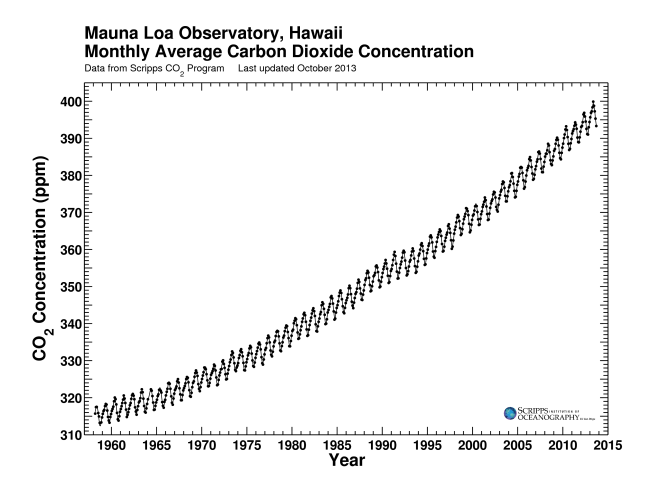
to keep it simple - The Earth breaths, and the green Trees are the lungs!!
so although Cows convert the suns energy into methane - which is a strong GHG, but is not the cause of the recent warming - that is not to say that Cows/Meat production and Land use are not important - just that they are NOT the cause, the cause is burning fossil fuels
so cow farts are essentially from within the earths "current account" in terms of energy so is not the cause of the recent warming
but when you burn Fossil Fuels you are in a sense burning "ancient sunshine" - which is not accounted for in the current earths energy budget
so you are adding net energy into the system that was not there before
oh and to add the current temps in the Arctic are 20c above the norm - unprecedented
that is like it being 70f on xmas day in the UK
the process is called "polar Amplification" and was a prediction made by AGW theory
further reading
https://en.wikipedia.org/wiki/Earth%27s_energy_budget
https://en.wikipedia.org/wiki/Polar_amplification
Last edited by hodgy0_2; Feb 28, 2018 at 04:59 PM.
18 June 1815 - Waterloo
iTrader: (31)
Joined: Dec 2004
Posts: 19,156
Likes: 15
From: To the valley men!
are cows the cause of global warming?
Err in a word NO
why - well because of something called the earths "Carbon Budget" - the Earth creates natural CO2 / Methane etc and absorbs CO2 / Methane etc in natural cycles
so the Northern hemisphere summer, CO2 is absorbed in the greening of all the trees and plants - that's why the keeling curve is saw toothed in shape
to keep it simple - The Earth breaths, and the green Trees are the lungs!!
so although Cows convert the suns energy into methane - which is a strong GHG, but is not the cause of the recent warming - that is not to say that Cows/Meat production and Land use are not important - just that they are NOT the cause, the cause is burning fossil fuels
so cow farts are essentially from within the earths "current account" in terms of energy so is not the cause of the recent warming
but when you burn Fossil Fuels you are in a sense burning "ancient sunshine" - which is not accounted for in the current earths energy budget
so you are adding net energy into the system that was not there before
oh and to add the current temps in the Arctic are 20c above the norm - unprecedented
that is like it being 70f on xmas day in the UK
the process is called "polar Amplification" and was a prediction made by AGW theory
further reading
https://en.wikipedia.org/wiki/Earth%27s_energy_budget
https://en.wikipedia.org/wiki/Polar_amplification
Err in a word NO
why - well because of something called the earths "Carbon Budget" - the Earth creates natural CO2 / Methane etc and absorbs CO2 / Methane etc in natural cycles
so the Northern hemisphere summer, CO2 is absorbed in the greening of all the trees and plants - that's why the keeling curve is saw toothed in shape
to keep it simple - The Earth breaths, and the green Trees are the lungs!!
so although Cows convert the suns energy into methane - which is a strong GHG, but is not the cause of the recent warming - that is not to say that Cows/Meat production and Land use are not important - just that they are NOT the cause, the cause is burning fossil fuels
so cow farts are essentially from within the earths "current account" in terms of energy so is not the cause of the recent warming
but when you burn Fossil Fuels you are in a sense burning "ancient sunshine" - which is not accounted for in the current earths energy budget
so you are adding net energy into the system that was not there before
oh and to add the current temps in the Arctic are 20c above the norm - unprecedented
that is like it being 70f on xmas day in the UK
the process is called "polar Amplification" and was a prediction made by AGW theory
further reading
https://en.wikipedia.org/wiki/Earth%27s_energy_budget
https://en.wikipedia.org/wiki/Polar_amplification
Scooby Regular
Joined: Jul 2008
Posts: 15,634
Likes: 22
From: K
the fact that fossil fuels are a "net" addition to the earths energy budget
ergo the planet retains energy/heat, ergo it warms
Last edited by hodgy0_2; Feb 28, 2018 at 09:10 PM.
Thread Starter
Scooby Regular
iTrader: (1)
Joined: Aug 2004
Posts: 6,296
Likes: 118
From: Api 500+bhp MD321T @91dB Probably SN's longest owner of an Impreza Turbo
Euro6 diesel still polluting multiple level above
https://www.telegraph.co.uk/science/2018/03/02/diesel-cars-marketed-cleanest-history-still-belching-dangerous/
Joined: Apr 2002
Posts: 38,078
Likes: 310
From: The hell where youth and laughter go
Just shows the EU regs are pointless.
Until registered vehicles and installed appliances (such as boilers) are individually tested regularly throughout their life, then this will keep on happening.
Nox testing at MOT could be implemented if they wanted. The gas analysers already calculate CO2 and most current units have expansion ports to allow for the retrofitting of a NoX sensor.
Until registered vehicles and installed appliances (such as boilers) are individually tested regularly throughout their life, then this will keep on happening.
Nox testing at MOT could be implemented if they wanted. The gas analysers already calculate CO2 and most current units have expansion ports to allow for the retrofitting of a NoX sensor.
Scooby Regular
Joined: Jul 2008
Posts: 15,634
Likes: 22
From: K
NOX and CO2 are two completely different kinds of pollutant
NOX - bad for the human respiratory system / human health
CO2 - bad for the earths climate system (and ultimately potentially human existence on earth)
the future is clearly Electric - and who will be driving the Global standards on Electric cars
Clue - it will not be the UK
NOX - bad for the human respiratory system / human health
CO2 - bad for the earths climate system (and ultimately potentially human existence on earth)
the future is clearly Electric - and who will be driving the Global standards on Electric cars
Clue - it will not be the UK

Thread
Thread Starter
Forum
Replies
Last Post
2000TLondon
Non Scooby Related
4
Feb 20, 2006 09:57 AM
TelBoy
ScoobyNet General
8
Sep 19, 2002 01:36 PM
David Middleton
Non Scooby Related
3
Jan 12, 2001 11:33 AM

