


Fitness and Diet


Scooby Regular
Joined: Jun 2003
Posts: 48,539
Likes: 0



Scooby Regular
Joined: Jun 2003
Posts: 48,539
Likes: 0


Scooby Regular
Joined: Jun 2003
Posts: 48,539
Likes: 0

 You're a lightweight body builder, and you've done really well with all that oat eating.
  Honestly, very well-supported with your evidence.

Scooby Regular


Joined: Jul 2008
Posts: 15,634
Likes: 22
From: K


Scooby Regular
Joined: Jul 2008
Posts: 15,634
Likes: 22
From: K
forget the six pack - I have a party 7 -- lol
seriously though - all good stuff,
in my forties and 5 kids later I still run 2 or 3 half marathons year, ski and windsurf
and deffo nothing wrong with a bit pride in your appearance
I was lucky to be born with outstandingly good looks though
seriously though - all good stuff,
in my forties and 5 kids later I still run 2 or 3 half marathons year, ski and windsurf
and deffo nothing wrong with a bit pride in your appearance
I was lucky to be born with outstandingly good looks though

Scooby Regular
Joined: Jun 2003
Posts: 48,539
Likes: 0
Hey, nothing wrong with lightweight bodybuilder, hodgy. Even in boxing and stuff they have featherweight and heavyweight champions, yes?
Of course, you are, veerinder. You're in a real good shape. Don't listen to hodgy. He can be a bit of a poo stirrer sometimes. 

LOL he can be a jovial soul for a change sometimes, which is good.

LOL he can be a jovial soul for a change sometimes, which is good.
Scooby Regular
Joined: Jun 2003
Posts: 48,539
Likes: 0
What's the point in that?



Thread Starter
Scooby Regular
iTrader: (78)
Joined: Jul 2009
Posts: 9,451
Likes: 13
From: North West
Small Update:
At the start of all this I weighted 14.13 - 14.9 varied, but I used 14.9 as my start weight so not to kid myself I was losing more than I actually was.
My weight hasn't fluctuated which is good, it's either stayed the same or dropped off. By simply reigning in my food intake and sticking to under 2000 calories. The last few days have been a challenge for me to try and reduce the intake further, I've friends working through gone 5-2 diet, so with this in mind I had a faming day yesterday keeping my intake to a mere 635 calories, today having just had my Tea I've managed 1050 calories.
The hardest thing for me is the temptation and not eating the junk around the house. I've two young kids so crisps, biscuits and other snacks are to hand often. It's all too easy to eat quick snacking convienice foods, but the will power is holding out
Weighed yesterday am and this am at 13.11.
Rob
At the start of all this I weighted 14.13 - 14.9 varied, but I used 14.9 as my start weight so not to kid myself I was losing more than I actually was.
My weight hasn't fluctuated which is good, it's either stayed the same or dropped off. By simply reigning in my food intake and sticking to under 2000 calories. The last few days have been a challenge for me to try and reduce the intake further, I've friends working through gone 5-2 diet, so with this in mind I had a faming day yesterday keeping my intake to a mere 635 calories, today having just had my Tea I've managed 1050 calories.
The hardest thing for me is the temptation and not eating the junk around the house. I've two young kids so crisps, biscuits and other snacks are to hand often. It's all too easy to eat quick snacking convienice foods, but the will power is holding out
Weighed yesterday am and this am at 13.11.
Rob

Scooby Regular
iTrader: (1)
Joined: Aug 2004
Posts: 6,296
Likes: 118
From: Api 500+bhp MD321T @91dB Probably SN's longest owner of an Impreza Turbo
The first few weeks you can lose quite a bit of weight, saying that, ideally you need to lose 2lb a week. Try and ween the kids to have less sweet stuff. Exercise is the way to burn extra calories so you don't need to starve yourself.

Scooby Regular
Joined: Jan 2011
Posts: 446
Likes: 0
From: Dundee
The quicker you lose the weight, believe it or not, the quicker you will put it back on when you inevitably up the calories. First couple of weeks are always pretty decent mind you but you shouldn't be starving yourself with less than 1200 calories a day, you think you're doing yourself favours but you're not. You are slowing down your metabolism, losing water and muscle weight and not eating regularly enough. You need to be eating 5-6 x a day and aiming for 1.5-2lbs of fat loss a week. Yes, it may sound like slow progress but that's exactly what you want, slow and steady wins the race. You really need to be careful here, so I would probably advise upping your daily intake, eating regularly and letting it come off slowly.
Best of luck. What's your target weight?
Best of luck. What's your target weight?
Last edited by LEO-RS; Mar 26, 2014 at 09:52 PM.

Scooby Regular
Joined: Nov 2000
Posts: 18,658
Likes: 1
From: 32 cylinders and many cats
I've been trying to increase protein (eggs, nuts, seeds, lean meat) and dramatically reduce high GI foods including dates and more than occasional fruit juices and not have biscuits/cake/chips/crisps etc except very occasionally, more oats/nuts etc instead, and about a glass of wine a week. I don't feel hungry all the time, and when I was handed a piece of birthday cake by a colleague I didn't really enjoy it as it felt like I was just eating sugary junk with no nutrition value. BMI as I approach 40 has become 25. I appear to be losing about 0.5kg per week and feel I can sustain it as it isn't miserable, excessively calculated or prohibitive.
Scooby Regular
Joined: Nov 2000
Posts: 18,658
Likes: 1
From: 32 cylinders and many cats
Short reply: Surely you don't think I'm that undiscerning?
Long reply: A bit of real world perspective is needed here... I'm not an athlete, neither are the vast majority of my patients. In my and their cases, BMI is a useful yardstick just as is the "normal" range of resting pulse of between 60 and 100 which also doesn't apply to athletes who often have a resting pulse that is at a level where a sedentary, unfit person has heart block and would merit a pacemaker. Most of my patients that object to the use of BMI are using that objection as part of their denial mechanisms and funnily enough it doesn't come up or is not even calculated when someone has an obvious athletic physique. The last guy that objected to BMI being used had hypertension, high cholesterol and type 2 diabetes, in the past he had been muscular but had continued to eat the same as when he used to train, added a load of junk food and was now completely sedentary. He had abnormal LFTs and an ultrasound showed a fatty liver that would have made nice foie gras. These characters are my concern, not muscular athletes. Have you considered this perspective as a jobbing GP and what would you propose as a time and cost effective alternative as a screen in people with risks for or new diagnoses of diabetes, hypertension, heart disease, thyroid disease, mental health disorders etc who are all quite well served by BMI assessments? I spend all day using tests that have a normal range and am very familiar indeed with their limitations, the artificial imposition of normal distribution curves upon them with sharp normal-abnormal cutoffs and look for consistent data from a variety of sources rather than make a judgement on one figure. In my individual case, my rising BMI that has occurred through my 30s has been associated with less exercise (redressed), relatively sedentary job (junior doctors can lose weight through the miles they walk on long shifts, now I walk only 20m to get each patient) and increasing waist size, so some correlates are there along with the BMI to say I was becoming overweight.
Long reply: A bit of real world perspective is needed here... I'm not an athlete, neither are the vast majority of my patients. In my and their cases, BMI is a useful yardstick just as is the "normal" range of resting pulse of between 60 and 100 which also doesn't apply to athletes who often have a resting pulse that is at a level where a sedentary, unfit person has heart block and would merit a pacemaker. Most of my patients that object to the use of BMI are using that objection as part of their denial mechanisms and funnily enough it doesn't come up or is not even calculated when someone has an obvious athletic physique. The last guy that objected to BMI being used had hypertension, high cholesterol and type 2 diabetes, in the past he had been muscular but had continued to eat the same as when he used to train, added a load of junk food and was now completely sedentary. He had abnormal LFTs and an ultrasound showed a fatty liver that would have made nice foie gras. These characters are my concern, not muscular athletes. Have you considered this perspective as a jobbing GP and what would you propose as a time and cost effective alternative as a screen in people with risks for or new diagnoses of diabetes, hypertension, heart disease, thyroid disease, mental health disorders etc who are all quite well served by BMI assessments? I spend all day using tests that have a normal range and am very familiar indeed with their limitations, the artificial imposition of normal distribution curves upon them with sharp normal-abnormal cutoffs and look for consistent data from a variety of sources rather than make a judgement on one figure. In my individual case, my rising BMI that has occurred through my 30s has been associated with less exercise (redressed), relatively sedentary job (junior doctors can lose weight through the miles they walk on long shifts, now I walk only 20m to get each patient) and increasing waist size, so some correlates are there along with the BMI to say I was becoming overweight.
Last edited by john banks; Mar 28, 2014 at 02:24 PM.
Scooby Regular
Joined: Nov 2000
Posts: 18,658
Likes: 1
From: 32 cylinders and many cats
Time and cost effectiveness? Your world and the world of the obese patient that is in denial are polar opposites. BMI is widely understood, very fast, often calculated automatically by clinical IT systems where you already have height entered so just need to update weight. It is also commonly used in medical studies for risk stratification, in some cases has cutoffs for obesity related drugs or surgery. BMI recording in diabetes is incentivised by performance related funding which in turn is supposed to be evidence based. The pitfalls in those using it blindly to tell athletes who know far better that they are overweight only really arise in registration medicals or insurance reports on fit people, and they usually ask for waist size, so a waist size of 30" and BMI of 30kg/m2 except in someone very short should arise suspicion.

Scooby Regular
Joined: Jun 2013
Posts: 353
Likes: 0
From: Dudley

Scooby Regular
Joined: Mar 2002
Posts: 14,629
Likes: 0
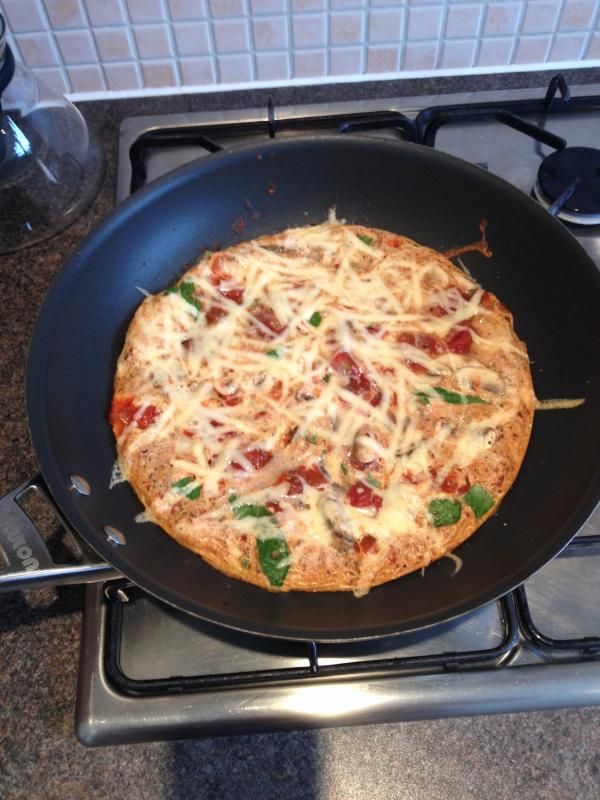
Ok, I'm made an amazing discovery. I've figured out how to make an omelette pretty much taste like a pizza. Use the following:
2 whole eggs
4 egg whites
35g of low or half fat cheese
Salsa to taste
Mushroom to taste
Spinach to taste
Method:
1. Spray a large pan with 5 squirts of 1 cal olive oil spray.
2. Crack eggs into bowl and whisk. I personally add some paprika and curry powder for extra taste
3. Heat the pan to a medium heat and add the eggs.
4. Having separately cooked the mushrooms in 5 squirts of olive oil add them evenly to the omelette as it cooks.
5. Rip up and add spinach evenly
6. OPTIONAL: you could also add some chicken strips or ham if you want
7. Add the cheese evenly across the omelette and allow it to cook most of the way through.
8. Spoon generous amounts of salsa evenly throughout the omelette and place it under a grill to melt the cheese and heat the salsa.
9. Remove and serve by folding in half like a Calzone. Enjoy.
Picture attached, every aspect of this was weighed on a digital scale and logged on MyFitnessPal. Total calories 400: 46g of protein, 20g of fat and 5.5g of carbs
2 whole eggs
4 egg whites
35g of low or half fat cheese
Salsa to taste
Mushroom to taste
Spinach to taste
Method:
1. Spray a large pan with 5 squirts of 1 cal olive oil spray.
2. Crack eggs into bowl and whisk. I personally add some paprika and curry powder for extra taste
3. Heat the pan to a medium heat and add the eggs.
4. Having separately cooked the mushrooms in 5 squirts of olive oil add them evenly to the omelette as it cooks.
5. Rip up and add spinach evenly
6. OPTIONAL: you could also add some chicken strips or ham if you want
7. Add the cheese evenly across the omelette and allow it to cook most of the way through.
8. Spoon generous amounts of salsa evenly throughout the omelette and place it under a grill to melt the cheese and heat the salsa.
9. Remove and serve by folding in half like a Calzone. Enjoy.
Picture attached, every aspect of this was weighed on a digital scale and logged on MyFitnessPal. Total calories 400: 46g of protein, 20g of fat and 5.5g of carbs

Last edited by Saxo Boy; Mar 28, 2014 at 10:25 PM. Reason: Correcting typo spotted by JB

