When you click on links to various merchants on this site and make a purchase, this can result in this site earning a commission. Affiliate programs and affiliations include, but are not limited to, the eBay Partner Network.
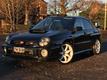
Currently I have 18" Rota P1 alloys on my Bugeye, Im thinking of changing them but read mixed feelings on if to go to 17" or another set of 18" Alloys.
I prefer 17's because you don't have to worry so much about kerbing your rims with the bigger sidewall dimension, also makes the ride slightly softer and I like a bit of give in my tyres, 18's are a pain in the bottom always wondering when the next kerbing is coming and dodging even the smallest of pot holes gets boring real quick.
Oh and 17 tyres are cheaper too.
Last edited by ditchmyster; Oct 17, 2016 at 07:26 AM.
Currently I have 18" Rota P1 alloys on my Bugeye, Im thinking of changing them but read mixed feelings on if to go to 17" or another set of 18" Alloys.
What are peoples views & why?
18's came as standard on the UK300 and were an option from the dealer at the time for Bugeye cars. The P1 wheels are quite heavy compared to others on the market so go for something that will decrease the sprung/wheel weight at each corner.
The suspension set up will help with the ride and be careful when you park the car to prevent kerbing.
The optimal sidewall on a sports road car is 45 to 55 profile.
Any less than that, and it's all about looks, brake capacity you don't need and additional unsprung weight.
Keeping compliance in the sidewall means more grip and traction - the pneumatic response of the tyre, being quicker than anything the suspension can manage.
Discuss......
Had 18's on my last bug inovite's with 225 40 18 tyres on and must say looks wise I liked but drive wise the 17's are much more comfy if you will it's not black but alloys are white @ 7.5j
225 x 40 x 18 are recommended for 18 x 8.5 wheels as this maintains the original gear ratios. Also most bigger brake kits won't fit behind 17" wheels so 18s are the only option. Of course if the motor and brakes are bog standard then there is no point going for 18s other than for looks as 17s are more comfortable. And if you keep curbing rims then you might need to re-assess your parking techniques!
Some thoughts:
Yes, car companies love big alloys - think of the bigger profit margins. But, additional rotating mass is a disadvantage.
Because a tyre is wider, doesn't mean it's contact patch is bigger - it's construction dependent.
A sticky compound, wide, tyre might be helpful on a dry, flat, surface (assuming your Impreza suspension can maintain camber? In which case, it's not a compliant road suspension). But, if a wider tread/stiffer sidewall combination can't deform to a rougher road surface, then, again, you're at a disadvantage.
Hence my earlier comment about 45-55 aspect road tyres, irrespective of width. Rolling radius might be maintained by moving to a wider, lower profile tyre. But that doesn't mean that a wider tyre, due to its construction, has the same level of compliance, as a narrower tyre.
That's leaving aside, the wider tyres aquaplaning, tramlining and reduced warning of breakaway at the limit.
Some thoughts:
Yes, car companies love big alloys - think of the bigger profit margins. But, additional rotating mass is a disadvantage.
Because a tyre is wider, doesn't mean it's contact patch is bigger - it's construction dependent.
A sticky compound, wide, tyre might be helpful on a dry, flat, surface (assuming your Impreza suspension can maintain camber? In which case, it's not a compliant road suspension). But, if a wider tread/stiffer sidewall combination can't deform to a rougher road surface, then, again, you're at a disadvantage.
Hence my earlier comment about 45-55 aspect road tyres, irrespective of width. Rolling radius might be maintained by moving to a wider, lower profile tyre. But that doesn't mean that a wider tyre, due to its construction, has the same level of compliance, as a narrower tyre.
That's leaving aside, the wider tyres aquaplaning, tramlining and reduced warning of breakaway at the limit.
18" for show, 17" for go, ..... not my saying but probably true.
Makes you think does that saying as the s203/ and some others come with 18" as standard so how's 18"show? Now 19's that's like a **** on high heels
Just my 20p's worth
Makes you think does that saying as the s203/ and some others come with 18" as standard so how's 18"show? Now 19's that's like a **** on high heels
Just my 20p's worth
Agree about the 19"" wheels, my car has 18" wheels and coilovers so not good over the bump, pot holes ridden roads in this country. Personally I think 18's look better than 17's.
Agree about the 19"" wheels, my car has 18" wheels and coilovers so not good over the bump, pot holes ridden roads in this country. Personally I think 18's look better than 17's.
Totally agree on the 18's if I was to ever go 18" I would only have these on mine and maybe one day I will
Makes you think does that saying as the s203/ and some others come with 18" as standard so how's 18"show? Now 19's that's like a **** on high heels
Just my 20p's worth
Manufacturers are in business to provide what people want. For most people larger rims are more appealing and a small sacrifice in handling doesn't matter. The S203 would handle slightly better on the road with 17s generally speaking, but wouldn't look nearly as good.
Having said that, as 53 points out there are many variables at play and it's not as simple as just saying 17>18. For example my Rota 18x8.5 with Goodyear Assy 2s 225/40/18 are 1 kg lighter per wheel than OEM Enkei 17x8 with Federal 595 RS-R 235/45/17, most likely due to the much stiffer/heavier sidewall on the Federals. This also means that despite the lower profile the 40-section 18s with Goodyears offer a comparable level of compliance to the 45-section 17s with Federal.
There's no doubt, that an Impreza on oem suspesion, during high-speed cornering, needs a somewhat stiffer construction tyre. As there's a significant change in front camber, due to the MacPerson struts. But, if sidewall stiffness was that important to performance, we'd all be on run-flats.
What I was considering, is that the construction of wider performance tyre, needs a stiffer carcass. As the wider tyre has to maintain a wider, but narrower contact patch - otherwise, why bother fitting a wider tyre? Problem is, what happens when you hit a bump mid-corner? As you are likely to do, on a British road, with an uncompliant tyre/suspension - grip, no grip, traction, no traction.
Why UK so-called performance suspensions are tailored to flat roads, or designed and tested at the Nurburgring, I don't know.
With the current state of British roads, we should be getting the suspensions spec'd for Southern Europe.
I'd go:
205/55x16 or 215/45x17 on a classic.
215/45x17 or 225/45x17 on a newage.
The point is 45 is a percentage not a fixed profile on which to make generalisations. A 45 profile on an 235/18 is not the same as a 45 profile on a 17" rim, it equates to a 55 on a 17" Forester fitment Likewise a 40 profile is perfect on a classic 17" 215. How are you then comparing JDM to UK 225/235 with the same 45 profile. There is no perfect profile for all those reasons above and all the variations of tyres, the pressures they require to perform and how the car is being used.
I'm no expert but that's incorrect. The rim diameter has no bearing on the sidewall height like you say, it's a percentage of the tyre width so essentially a 235/45/17 & 235/45/18 the sidewall height is the same on both tyres.



 17" Or 18" And Why??